

Teaching Architecture, Living Art-chitecture

It is essential for human beings to engage in a meaningful dialogue with beauty, aesthetics, and the essence of life. From this perspective, architecture, alongside its theoretical and historical dimensions, should not be perceived as a distant relic or a static display locked within the confines of a museum, but must be understood as a living, breathing entity that continues to evolve and interact with the present. Architecture is not merely the study of buildings or physical forms; it is the study of human experience, existence, culture, and identity as they are expressed and shaped through space. At its core lies a deeper pursuit, the experience of beauty and meaning. What matters most is not simply to observe beauty, but to live it, to exemplify its values. As Plato perceives, beauty transcends boundaries, limitations, and even time itself. True beauty, in his view, is inseparable from truth, it is eternal, beyond life and death. In this light, architecture becomes a timeless dialogue between the material and the metaphysical, a medium through which beauty, as a form of truth, is continuously rediscovered, reimagined and lived. Within this framework of truth, beauty, and goodness in the context of education, the goal is to cultivate virtue, goodness and bringing beauty into every step of teaching.
Teaching both “History and Theory of Art, Architecture and Urban Design” and “Interior Design” courses at UNYT for about two years now, has offered and continue to offer me a complex yet deeply enriching educational experience. While these subjects may differ in their focus, one theoretical and reflective, the others practical and design-oriented, they are inherently interconnected. Together, they shape a comprehensive foundation for architectural education, guiding students toward becoming thoughtful, competent, and versatile professionals. This presents a profound challenge in architectural education: how to teach architecture, artefacts, urban forms, and historical narratives in ways that are both relevant and engaging in today’s rapidly changing world. It requires a pedagogical shift, from passive observation to active participation, from linear memorization to experiential learning. When students are encouraged to live history, to inhabit it through analysis, reinterpretation, and creation, their connection to the discipline deepens, becoming more personal and transformative. Theory and history, therefore, must not be approached as abstract or detached concepts. They must be integrated into the contemporary context in which students live, think, and create. This dynamic interpretation invites learners to perceive history not as a frozen timeline of events or styles but as a source of inspiration and critical reflection that informs present and future design decisions.
At the same time, interior design studios push students to ask essential questions about space: What is space? How do we feel it, inhabit it, and transform it? These questions mirror those raised in theoretical classes, suggesting that both subjects, though delivered through different methods, are in fact complementary. In both, the goal is the same: to educate architects and interior designers who can understand and shape the built environment with an awareness that is timeless, an ability to learn from the past, creatively respond to the present, and generate spaces that will one day carry historical, aesthetic, functional, and most importantly spiritual value.
Jean Piaget’s constructivist pedagogy, in which knowledge is built up from personal experiences, and Lev Vygotsky’s interactive model, in which the instructor facilitates students’ independent exploration and discovery, resist learning as passive absorption. Piaget saw learning as a process of adapting to reality by testing one’s ideas, while Sagdic & Kosova highlights innovative methods, like moviemaking, as effective tools in architectural history education. By employing these creative techniques, students actively immerse themselves in historical narratives, developing reflective and interpretative skills that traditional methods may not fully nurture. Further enhancing this interactive dimension, diverse pedagogical strategies are utilized, including lectures combined with rigorous classroom debates, field visits to historically significant sites, and critical analyses of architectural spaces. Additional active-learning activities involve students directly in the preparation of exhibitions and thematic artistic work. Moreover, constructing physical and digital 3D models, often supported by Artificial Intelligence technology, enables students to articulate and visualize their creative philosophies and interpretations effectively. Within this framework, the assignments and projects of the history and theory course are structured around exploring history through the creative and artistic expression of students. Exercises like “An Interactive Exploration of Modern Architecture” or “Reinterpreting Architects Philosophy through Artistic Expression” allow students to explore into the works and philosophies of renowned architects. Through posters, paintings, and 3D abstract compositions, they are encouraged to express their understanding of these architects’ worlds in artistic forms. This approach not only exposes students to the historical and theoretical knowledge within the course, but also promotes an emotional and enthusiastic engagement, enabling them to reinterpret and present this knowledge in their own unique style. It encourages diverse methods of expressing truth and knowledge, connecting the intellectual with the creative.
“We comfort ourselves by reliving memories of protection. Something closed must retain our memories, while leaving them their original value as images. Memories of the outside world will never have the same tonality as those of home and, by recalling these memories, we add to our store of dreams; we are never real historians, but always near poets, and our emotion is perhaps nothing but an expression of a poetry that was lost.”
― Gaston Bachelard, The Poetics of Space.
In this spirit, practical design studios become essential venues for engaging with deep questions about the nature of space, how it is perceived, experienced, and created, through hands-on practice, experimentation, and critical reflection. Most importantly, the interior design studio transforms into a blank canvas where students paint with their own brushes, a white page where each one writes their own poetry. The methodological approach is as poetic as it is technical, as abstract as it is concrete.
“You’re going to remember this day for the rest of your life.” -Richard McGuire, Here.
This quote highlights the pedagogical emphasis on appreciating the “here and now,” not only in spatial and professional dimensions but also emotionally and spiritually. Space, the “here,” becomes both the centre and the essence of exploration. Yet such a meaningful and spiritually resonant approach demands a careful balance: students must be engaged with foundational theoretical concepts while simultaneously grounding their learning in real-world, practical experiences.
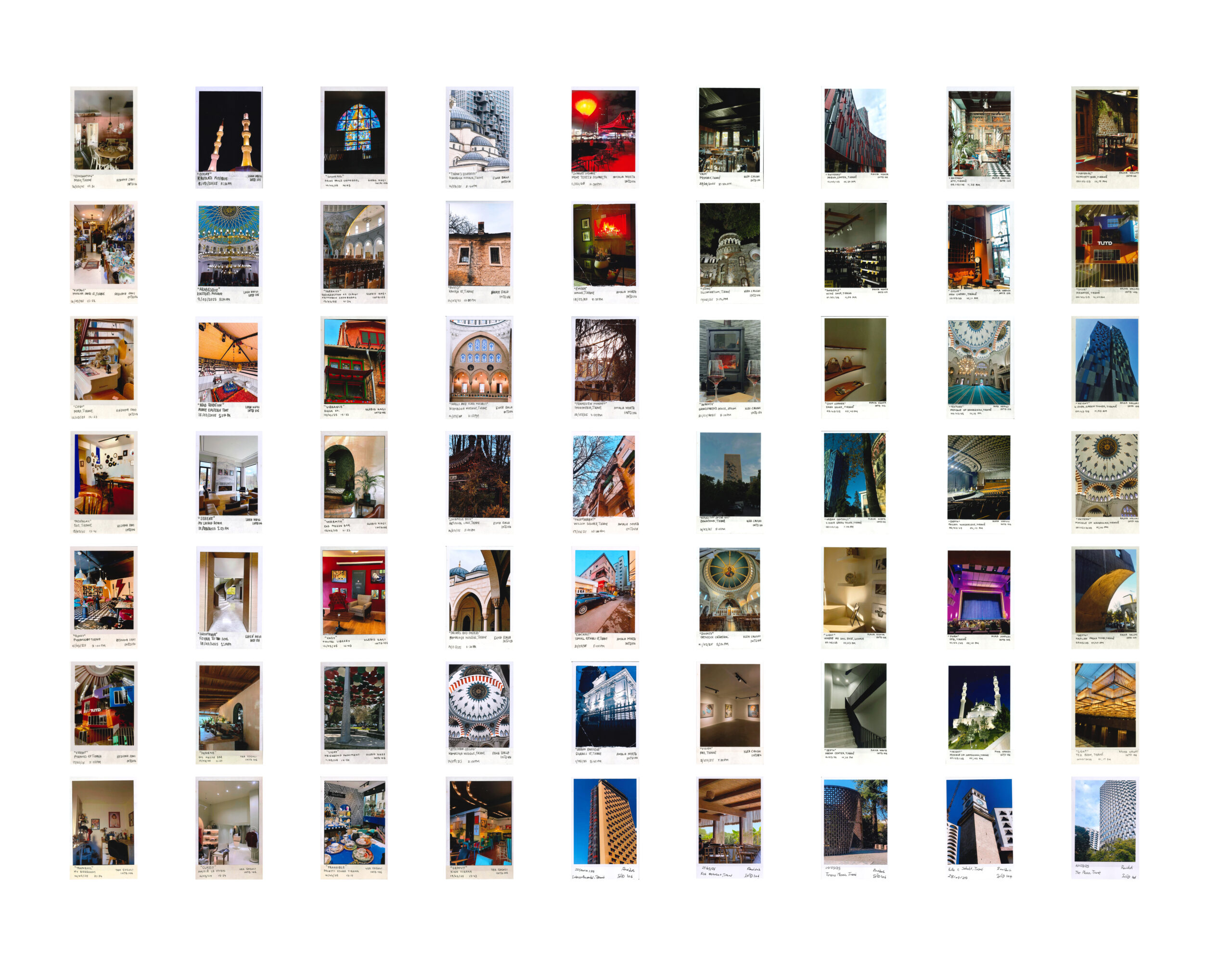
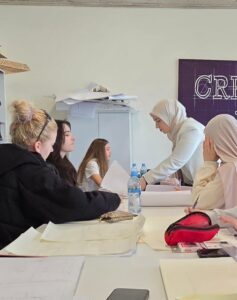
Throughout the semester in the interior design courses, students are given both short-term tasks and long-term projects designed to encourage and express this philosophy. A key element of the teaching approach was the close, step-by-step guidance we offer throughout their professional development. In their first year, students are introduced to the foundational concepts of interior design, core principles, an accurate understanding of the profession, and the cultivation of artistic sensibility. As they advance, they begin to apply these theoretical elements to real-world projects, such as villa design, hospitality spaces, showrooms, commercial and industrial interiors, institutional, and adaptive reuse of heritage spaces among others. They are exposed to diverse learning environments: field visits, explorations of the latest material trends in showrooms, discussions with well-established practitioners in the interior design field. Through a variety of tools such as sketching, drafting, 3D modelling, and visual renderings, students unfold their creativity, striving to capture beauty in all its dimensions: as a personal emotional response, and as a contribution to the broader social fabric. I believe that equipping students to understand their roles and societal responsibilities ultimately positions them as informed, reflective, and responsible contributors, both to the architectural profession and to the community at large.
A key factor in our ability to apply such a wide range of methods, some experimental, others well-established, is the nature of our department itself. As a new and dynamic academic unit, full of positive energy, it represents innovation, the spirit of the times, and most importantly, the present moment, with all its challenging dimensions. Being part of a team of colleagues who collaborate with dedication to shape a sustainable model for what architecture and design schools can and should be, is not only a professional privilege, but a rare gift in life.
As we celebrate the 5th anniversary of the Department of Architecture and Design, we stand at a meaningful spatial and temporal crossroads, a moment full of meaning, reflecting on our journey and working with vision and purpose to shape a better tomorrow. My hope is that the Department of Architecture and Design, just as it had a bright and promising beginning, will continue to grow and evolve each day—constantly striving for improvement in all aspects of academic and professional approach. For what we, as educators, expect of ourselves and our students is always one and the same: Archiving Excellence through Beauty and Virtue.
Brunilda Basha, Phd. Architect.


This study explores the potential of adaptive reuse as a premier strategy for the reutilization of forgotten historic buildings, with a particular case study of the Bazaar Hammam – a 15th-century Ottoman bathhouse landmark in Elbasan city, Albania. The Hammam now stands in a situation of partial abandonment and partial use, reflective of the wider …

A conversation with architect Brunilda Basha “Heritage in Transformation: Adaptive Reuse & Contemporary Architecture” where poetry becomes another lens for reading the city and understanding human experience, revealing the poetics inherent in architectural space. Brunilda Basha shares her insights on adaptive reuse and the careful preservation of historic buildings, exploring how heritage can dialogue with …